The best franchise territory mapping software is the system a franchisor uses to keep exclusive territories live and sell them. Franchisors use it beside CRM, GIS, and franchise-management tools — it does not replace them. In 2026 the deciding factor is whether prospects and head office see the same map.
Most platforms were built for internal analysis, not commercial growth. They help you draw boundaries and run reports, but they will not help a prospect understand the opportunity, or help your team convert that interest into a sold territory.
If you already have a map and need the rebuild sequence, use how to improve franchise territory mapping. For what mapping software is, why you need it, and where it sits in the franchise toolkit, see what is franchise mapping software. For a named network that completed the job in a day, see The Creation Station case study.
What franchise territory mapping software should do
Done properly, a territory mapping tool should help you:
- Sell territories faster — buyers invest in a clear opportunity, not a PDF. Market potential, coverage, and the exclusive boundary have to be visible in the recruitment conversation.
- Prevent conflict — who owns what, where marketing is allowed, and how expansion is structured must be the same in the agreement and on the live map.
- Turn insight into action — white space, expansion, and balanced territory value should become recruitment conversations, not another report.
You cannot sell what people cannot see. Spreadsheets, static PDFs, and internal-only GIS projects leave prospects unable to self-qualify and sales teams answering the same availability question by hand.
Quick comparison (who each tool is for)
| Tool | Best for | Key strength | Main limitation | Typical cost |
|---|---|---|---|---|
| BoundaryIQ | Growth + franchise sales | Public-facing territories, enquiry capture, live availability | Newer product vs legacy tools | Start for free |
| Smappen | Simple mapping | Fast, approachable mapping + demographic overlays | No sales / recruitment layer | $0–$399/month |
| Maptitude | GIS analysis | Powerful modelling and datasets | Complex; not built for conversion | ~$795/year |
| Atlas Mapping | Territory design | Franchise-specific methodology | Consultancy-led; less day-to-day SaaS | £££ |
| Newgrove Periscope | Location intelligence | Advanced analytics | Enterprise complexity and cost | ££££ |
| Zors | Operations | CRM + internal territory management | Limited buyer-facing experience | ££–£££ |
Where does mapping software fit in a franchise operating toolkit?
A franchise already has CRM, ops, GIS, and (often) a planning project. Mapping software is the geographic source of truth those tools should read — not a second CRM and not a GIS department. The full “what it is / why you need it / what to leave to other tools” answer is what is franchise mapping software. This page stays the shortlist of which mapping product to buy.
How the market actually breaks down
Most tools fit one of these buckets. Very few do the last one.
| Category | What it is designed to do |
|---|---|
| Mapping tools | Draw territories |
| GIS tools | Analyse data |
| Planning tools | Design networks |
| Ops tools | Manage franchisees |
| Growth platforms | Sell territories and drive conversion |
Top franchise territory mapping software (2026)
1) BoundaryIQ (best for growth, sales, and visibility)
Best for: Franchisors who want to sell territories faster and keep exclusive territories live in operations.
BoundaryIQ is built around commercial outcomes: visibility, enquiry capture, and a clearer buyer journey — with franchise territory management as the day-to-day ops layer.
Where it wins
- Public-facing maps so prospects browse live territories and self-qualify
- Territories connected to enquiries
- Postcode, local-authority, and custom boundaries
- 100+ UK datasets and POIs for pricing and expansion
- Live availability and pricing that head office and prospects share
Bottom line: plan territories, sell them, and keep the same map in operations.
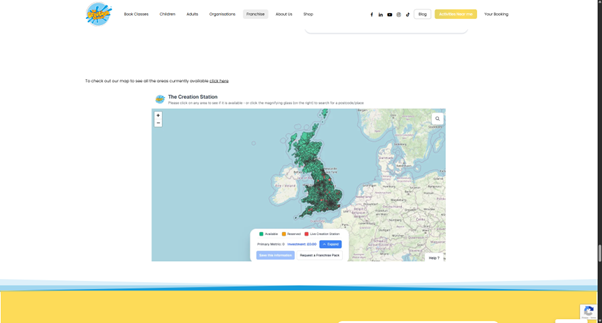
The Creation Station mapped 48 territories in a day on this pattern, cut lead routing by 60%, and awarded their highest-valued territory after the map went live. That proof sits on the Creation Station case study, not only on the public tenant map.
2) Smappen
Best for: Early-stage brands that want a straightforward mapping tool.
- Strengths: easy to use, fast territory creation, strong demographic overlays
- Limitations: no public-facing experience, no enquiry capture, no recruitment workflow
Good for planning. Not designed as the franchise operating map.
3) Maptitude
Best for: Data-heavy teams that need deep geographic modelling.
- Strengths: advanced datasets, modelling, optimisation
- Limitations: complexity, training overhead, not built for sales
Use GIS when you need a specialist model. Do not use it as the live exclusive-territory system. That is the GIS vs franchise mapping software split.
4) Atlas Mapping
Best for: Structured network planning with a franchise-specific methodology.
- Strengths: territory sizing, modelling, franchise-focused approach
- Limitations: consultancy-led, less scalable as day-to-day SaaS
Helps design territories — not sell them or run them next Tuesday.
5) Newgrove Periscope
Best for: Enterprise brands with internal analytics capability.
- Strengths: advanced analytics and modelling
- Limitations: cost, complexity, reliance on internal teams
Strategy tooling, not a recruitment engine.
6) Zors
Best for: Franchise operations and internal management.
- Strengths: CRM + territory mapping + analytics
- Limitations: internal focus, limited buyer-facing experience
Zors belongs in the ops column of the toolkit table. It helps manage franchisees. It is not the public map that converts prospects.
What actually matters when choosing a tool
Internal vs external. If the output is only for head office, you still need a way to show opportunity to buyers.
Static vs live. PDFs create friction. Live territories reduce back-and-forth.
Planning vs growth.
| Tool type | Typical outcome |
|---|---|
| Mapping tools | Define territories |
| GIS tools | Analyse territories |
| Planning tools | Design territories |
| Growth platforms | Sell territories |
Pricing: the question to ask
Many tools price on datasets, seats, and complexity. For a franchisor the better question is: will this help you sell more territories, faster?
Cheaper tools often cost lost deals, slower cycles, and more manual work. Compare commercial outcome, then look at franchise mapping software pricing.
FAQ
Is territory mapping the same as franchise management software?
No. Franchise management software runs the network: contracts, royalties, support, and often the franchisee record. Territory mapping software owns who has the exclusive area. The full definition — what mapping is, why you need it, and what to leave to ops — is what is franchise mapping software.
When should a franchisor use GIS vs franchise mapping software?
Use GIS (Maptitude and similar) when an analyst needs to model a network in depth. Use franchise mapping software when exclusive territories have to stay live, visible to prospects, and tied to enquiries. GIS is a specialist workshop. Mapping software is the map the rest of the business uses. Running only GIS usually means the live network still lives in a spreadsheet.
What does territory planning software cover that ops tools do not?
Territory planning software covers how areas are sized, balanced, and awarded — exclusive boundaries plus location analysis. Ops tools cover what happens after someone is in the network. If planning lives only in a consultancy slide deck, ops has nothing trustworthy to manage. Import the plan, then keep it current on the map.
What is the best franchise territory mapping software in the UK?
The best fit is the tool that keeps UK exclusive territories live and helps you sell them — postcodes, local data, and a map prospects can use. BoundaryIQ is built for that UK franchise job. Spreadsheets, generic mapping tools, and GIS platforms can support pieces of it; they rarely cover the full recruitment and operations loop.
Should we replace Smappen, MapInfo, or our CRM?
Replace the tool that is pretending to be the live territory system. Keep the CRM for people. Keep GIS for specialist modelling if you still need it. Keep franchise-management software for royalties and contracts. The mapping layer is what you add (or replace) when availability, exclusivity, and location analysis are not in one place.
Do we need to rip up franchisee agreements to change mapping software?
No. Start by mapping the awards you already have. The slower work is agreeing exclusive-territory rules and rerunning location analysis on unbalanced areas. How to improve franchise territory mapping is that sequence.
Next step
Start for free, or book a demo to see live territories, availability, and enquiry capture on one map.