
Franchise territory mapping is how a franchisor splits the map into exclusive areas and keeps ownership live. Franchisors use it to award territories fairly, run location analysis, and stop overlap disputes. In 2026 the deciding factor is whether you can evidence those decisions — not a spreadsheet of postcodes.
This guide is the practical sequence. For what mapping software is and why you need it in the wider franchise toolkit, see what is franchise mapping software. For a buyer’s shortlist of tools, use the 2026 franchise territory mapping software comparison. For a named network that completed the job in a day, see The Creation Station case study.
Why franchise territory mapping matters now
Outdated mapping creates commercial risk long before it shows up as a tribunal letter.
Unequal opportunity. One franchisee has 12,000 target households; another has 31,000. Same investment, different earning potential. Recruitment conversations become awkward, and you cannot defend the model if it is challenged.
No exclusive-territory record. The agreement may promise an exclusive area. If the live map, the CRM, and the original award notes disagree, you do not have a territory — you have an argument.
Weak location analysis. If you cannot show why a territory was sized that way (households, demographics, demand), buyers, banks, and franchisees treat the map as opinion.
Slow awards. Checking availability in inboxes and PDFs delays every new franchise. Prospects lose interest while head office hunts for the current version.
If your team could not answer a fairness question from a bank, buyer, or franchisee tomorrow, the mapping system is already a growth constraint.
How franchisors map territories
Use this sequence. Skip a step and the later ones will not hold.
-
Put every territory in one live view. Sold, reserved, pending, and available must be visible without opening a spreadsheet. If two people can give two answers for the same postcode, you do not have a map yet. Franchise territory management software is the operational layer for that status, owner, and pricing view.
-
Write the exclusive-territory rule in map language. One postcode (or drawn area) has one owner. Marketing rights follow the same line. Where you allow overlap, record it as a rule, not as an accident.
-
Run location analysis before you award or resize. Compare territories on the same metrics — households, income, family profile, competition — so two investments are actually comparable. Franchise territory data is what makes those comparisons evidence rather than instinct.
-
Keep a defensible record of every change. Who awarded the territory, on what date, with which boundaries and which dataset snapshot. Emails and “we’ve always done it this way” fail as soon as someone underperforms or asks for expansion.
-
Put the same map in recruitment. Prospects should see availability and boundaries in the sales conversation, not after they have already emotionally committed. A public map stops head office answering the same “is this area free?” question by hand.
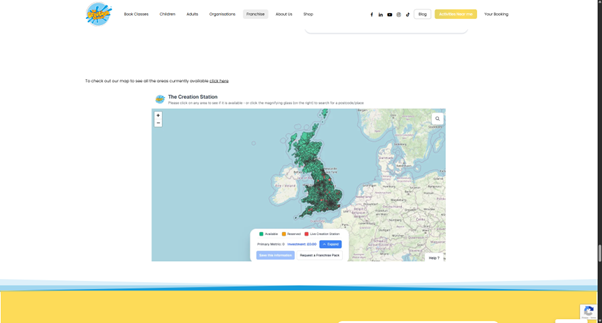
The Creation Station used this pattern to map 48 territories in a day, cut lead routing time by 60%, and award their highest-valued territory after the map went live. That is the proof point; the steps above are how any franchisor repeats it.
What good franchise territory mapping looks like
| Test | Weak system | Good system |
|---|---|---|
| Availability | Spreadsheet or PDF, version unknown | Live sold / reserved / available |
| Exclusive territory | Promised in the agreement, fuzzy on the map | One area, one owner, same line everywhere |
| Location analysis | Gut feel, or metrics that change per award | Same datasets, comparable territories |
| Disputes | Subjective, slow, email-based | Boundary + data snapshot you can produce |
| Recruitment | Head office describes the area | Prospect sees the area |
If you cannot tick the right-hand column, improving mapping is an operations project, not a design refresh.
Mistakes to avoid
- Treating GIS or a planning consultancy as the day-to-day system. Those tools design networks; they rarely run exclusive territories and enquiries. That split belongs on the comparison of franchise mapping software, not as a second how-to.
- Awarding exclusive territories that do not match the live map.
- Balancing territories by geography instead of location analysis (area size is not opportunity).
- Leaving the record of an award in someone’s inbox.
- Building a beautiful internal map that prospects never see.
FAQ
How do franchisors map territories?
They start from existing awards (postcodes, local authorities, or drawn shapes), load them into one live map, mark sold versus available, then adjust using location analysis so territories are comparable. The map becomes the source of truth for awards, marketing rights, and enquiries. Spreadsheets can feed the first import; they should not remain the system.
What is an exclusive territory in a franchise?
An exclusive territory is an area where one franchisee has the agreed right to operate, and others in the network do not. It only works if the boundary is identical in the agreement, the live map, and day-to-day management. If two franchisees can both claim the same postcode, you do not have exclusivity — you have a dispute waiting.
How do you do franchise location analysis?
Pick a small set of metrics that match how the franchise actually earns (households, income, family stage, nearby demand or competition). Score every territory on the same metrics before you award, price, or split an area. The point is comparability: a candidate should see why this territory is worth the investment relative to others you have already sold.
How do you reduce franchise territory disputes?
Publish one map, one exclusive-territory rule, and one record of each award. Most disputes are not about personality; they are about two versions of the truth. When a franchisee asks to expand, or underperforms, you should be able to show the original boundary and the data used to size it.
What does a defensible territory record look like?
A date, a named decision-maker, the boundary as it was awarded, and the location-analysis snapshot used at the time. That is enough for a buyer, a bank, or a franchisee challenge. “We think the territories are roughly balanced” is not.
How long does it take to remap a franchise network?
If current awards are in a usable list, a network can be visualised in a day — The Creation Station mapped 48 territories that way. The slower work is agreeing exclusive-territory rules and rerunning location analysis on unbalanced areas. Do not wait for a full legal rewrite before you put the live map in place.
Next step
You do not need to rip up contracts or hire a consultancy to start. Import the network you already have, lock exclusive territories to the map, and run location analysis on the outliers.
Try the demo map or start for free.


